THIS BLOG HAS MOVED TO resistancenews.org

vendredi 10 février 2017

Syria’s Assad & US Reporter battle over Human Rights Violations/War Crimes

Bashar al Assad's interview with Yahoo News, February 10, 2017

Transcript:
 
Mr. President. Thanks for giving us the opportunity. This is your first interview with American media since President Trump has taken office. Have you had any communications with President Trump directly or indirectly, or anybody in his administration?
No, not yet.
This is an opportunity for you to convey a message to President Trump, if you have one. What would you like to say to him?
I wouldn’t convey the message through the media. I would send it through different — channel, maybe diplomatic channel. But any message for us is the public one. We don’t have two messages. We have one stand, one position toward what’s happening in Syria. And it’s about fighting terrorism.
You said yesterday, I believe, that what you have heard from the new administration is “promising.” Explain what you meant.
The position of President Trump since he started his, the campaign for presidency till this moment is that the priority is to fight terrorism. And we agree– about this priority. That’s our position in Syria. The priority is to fight terrorism. And that’s what’s mean, what I mean by promising.
You indicated that you thought there was some way for cooperation between the United States and Syria. But you didn’t explain what that would be. What sort of cooperation can you envision?
Against terrorists and against terrorism. That’s– self-evident for us. This is beside having cooperation between any two nations, but in the meantime, in these circumstances, the priority is to have cooperation in fighting terrorism between the different nations, including Russia and Iran and Syria of course.
The president has tasked his Secretary of Defense with developing plans for — defeating ISIS — or Daesh Among the proposals  they are reportedly considering is using more special forces and even military assets such as Apache helicopters inside Syria. And arming Kurdish fighters who are fighting– Daesh in the North. If such moves would defeat ISIS., would you welcome them?
Could the– American prowess defeat the terrorists in Afghanistan or in other place? No. It cannot. It is not enough to have these Apache or F-16 or F-35, whatever want to– to– to label it– to defeat a terrorist. It’s more comprehensive way of dealing with that complicated issue.
So if you want to start genuinely as United States to do so, it must be through the Syria government. We are here. We are the Syrians. We– we– we own this country as Syrians. No– nobody else, nobody would understand it like us. So you cannot defeat the terrorism without cooperation with the people in the government of any country.
But you have welcomed Russian troops into your country. Would you welcome American troops into your country?
We invited the Russians, and the Russians were genuine regarding this– issue. If the Americans are genuine, of course they are welcome. Like any other country, we want to defeat and to fight– the terrorists. Of course with no hesitation we can say that. But–
So you want American troops to come into Syria to help fight ISIS?
Troops is part of the cooperation. Again, let’s go back to the comprehensive. You cannot talk about sending troops, if you’re not genuine, if you don’t have a clear political position toward not only the terrorism, toward the sovereignty of Syria, toward the unity of Syria.
All these factors would lead to– to trust where you can send your troops. That’s what happened with the Russians. They didn’t only send their troops. First of all, there’s a clear political position regarding the– those factors. This is where the Russians could come and succeed in fighting the terrorists and say–
Do you see cooperation between the United States and Russia to attack ISIS in Syria?
It is essential. Any cooperation in any conflict around the world, it needs the– let’s say the rapprochement between the Russians and the Americans. It’s very essential. Not only for Syria–
Well, you you talk to the Russians all the time, don’t you?

Of course, yes.

Yeah? When’s the last time you spoke to President Putin?

Few weeks ago.

All right. What’d you talk about?

About the problems in Syria. (LAUGH) About the advancement– of the Syrian Army in Syria–

Okay. So are you going to try– right. Are you going to try to broker some sort of arrangement between the United States and Russia in this fight?

There’s direct– contact between them. And– President Putin had a telephone call with– President Trump– week or– or so. And they talked about the different issues, including Syria. So they don’t need my role to– to do so. And we don’t have any contact with the Americans to help the Russian make– contact or improve their relations. We’re not in that position.
President Trump also recently said he, “absolutely wants to create safe zones inside Syria to protect refugees.” And possibly allow many of them to return. If such a move would help protect your country’s endangered citizens, would you support that?
Actually, it won’t– it won’t. Safe zone for the Syrians could only happen when you have– stability and security. Where you don’t have terrorists. Where you don’t have flow and support of those terrorists by the neighboring countries or by Western– countries.
This is where you can have natural safe zones, which is our country. They don’t need safe zones at all. It’s much more– viable, much more practical and less costly to have stability than to create safe zones. It’s not realistic idea at all.
Upwards of half of your country’s population has been displaced. How can you say that safe zones to protect them from bombardment would not be helpful?
The first thing you have to ask, “Why were they displaced?” If you don’t answer that question, you cannot answer the rest. Were displaced for two reasons. First of all, the terrorist acts and the support from the outside. Second, the embargo of Syria. Many people didn’t only leave Syria because of the security issues.
As you see, Damascus is safe today. You– it– it’s nearly n– normal life, not completely. But– they don’t– find a way for life in Syria. So they have to travel abroad in order to find their living. So if you lift the embargo and if you stop supporting the terrorists. I’m not talking about the United States, I’m talking about– about everyone who supported terrorists, including the United States during Obama’s administration. If you stop all these acts, most of those people will go back to their country.
There are, what? 4.8 million Syrian refugees since this crisis began. Just as way of comparison, that is more than four times the total number of Palestinian refugees from the events of 1947 and ’48. Do you accept that this is a humanitarian disaster?
It is a humanitarian disaster created by the Western support of those terrorists of course, and the region supported by Turkey and Qatar and Saudi Arabia. It didn’t happen just like this.
And do you bear any responsibility at all for this disaster?
As president?
Yes.
Regarding the policies that I undertake since I be, since the beginning of the crisis were– supporting the dialogue between the Syrians, fighting terrorists, and supporting reconciliation. And they succeed. So no. Regarding these policies, I think we are correct. And we are continuing on these pillars for– for the future of– of– of Syria, regarding this crisis.
As you know, President Trump has signed a very controversial executive order barring refugees– immigrants from predominantly Muslim countries, but specifically all Syrian refugees, saying that “Their entry into the country would be detrimental to the interests of the United States.” The premise is that some of them are terrorists. Do you agree with President Trump on this?
This question has two aspects. The first one is American. This is American issue, and it’s related to the sovereignty of the American– nation. Every country has the right to– put any regulations to enter their country. We can disagree and or agree.
But if you ask me as president, as official in Syria and the Syrian state, my– responsibility not to go and ask any president to allow the Syrians to go there and to have refu– refuge in that country. My responsibility is to restore the stability in order to bring them back to Syria and find refuge in their country. So I’m not going to discuss that this is right or wrong. This is American issue.
But the question was, “Are some of these refugees in your view aligned with terrorists?”
Oh definitely. And–
Definitely.
Definitely. You can find it on the net. The same picture that you saw them, in some cases of course, in some instances, those terrorists in Syria holding the machine gun or killing people, they are– peaceful refugees in– in Europe or in the West in general. Yeah, that’s true. It–
So how many terrorists do you believe are among the 4.8 million Syrian refugees–
No one– no one has any number. Nobody knows. Because nobody knows–
Do you believe it’s a significant number?
Because nobody knows all the terrorists to give a percentage. No one at all, invisible.
 Do you believe it’s a significant number?
It’s not about significant, ’cause you don’t need significant number to commit atrocities. 11th of September– it happened by only 15– terrorists out of maybe millions of immigrants in the United States. So it’s not about the number. It’s about the quality. It’s about the intention.
So if what you’re saying is correct, then President Trump would be justified in keeping them out of the United States.
I’m not American to justify it. Only as American people who say “This is against the interests of the United States or with the interests.” From our side, we can discuss it as value. This is with the value of the humanitarian situation in the world or not. That’s how we can discuss it. But again, I can only speak as president. For me the priority is to bring those citizens to their country. Not to help them immigrate. That is the natural duty, according to the constitution and to the law.
Would you welcome all of Syria’s refugees back into your country?
Definitely– definitely.
Definitely. Even the terrorists?
I don’t have to welcome them as president. I don’t own the country. It’s not my house. It’s not my company. It’s not my farm. This is country to every Syrian.
But if you believe that some of them are terrorists, what would you do with them when they return to Syria?
It doesn’t matter what I believe. What’s matter is what the law would say about every person committed any act against this country. Take into consideration that we give amnesty in Syria– to thousands of– people who committed– actions or acts  against their country as part of the reconciliation.
How do you expect them to return? What is your vision or plan for bringing Syria’s refugees back into Syria?
Already many of them, not a huge number, but many of them st– came back to Syria. Many of them. In spite of the– security issues and the embargo. So the majority of Syrians would like to come back to their country. This is natural for every citizen. They will come back when they– when there’s security and where there’s no embargo.
Your military just last month drove the rebels from Eastern– Aleppo. Do you see this as a turning point in Syria’s Civil War? And do you believe you’ve now won this war?
No, it’s not turning point. Turning point was when we took the decision to fight terrorism in spite all the propaganda against us abroad. Especially in the West, and against all, every pressure. This is, that was the turning point. Aleppo is– important steps against the terrorists, in the fight against terrorism.
But I cannot say a turning point, because we’re still going in the same way in the same direction. We haven’t changed our direction. Maybe for the terrorists a turning point? They better answer. Maybe for their– masters in the West and in the region, it could be. But they have to answer. I cannot answer on their behalf.
I was asking you before about potential cooperation between the United States and Syria. But the problem that many would have with that is the continued allegations of human rights abuses by your government. Now just today, we have a new report from Amnesty International — about — Saydnaya prison, human slaughterhouse they call it, 5,000 to 13,000– detainees hanged in mass in mass hangings there. Horrific conditions. Trials of blindfolded prisoners, one to three minutes– in length. No lawyers. Secret, all in secret. These, this would on its face be contrary to every aspect of international law. What do you know about what’s going on in that prison?
Let’s first of all talk about the first part of your question, which is the problem how to for the United States to open relation with Syria regarding the human rights. I will ask you, how could you have this close, very close relation and team relation with Saudi Arabia? Do you consider behaving as a human right– criteria?
Yes, but I’m not interviewing the King of Saudi Arabia right now. I’m– I’m interviewing you.
Yeah, I know, but–
I’m asking you about reports of human rights abuses in your prison, in your country–
Yeah, of course, yeah– yeah. You own the question, I own the answers. So that’s my answer. (LAUGH) So when you answer about Saudi Arabia and your relation, you can put your pos– on that position. Second, the United States is in no position to talk about human rights. Since Vietnam war till this moment, they killed millions of civilians. If you don’t want to talk about the 1.5 million in Iraq without any– s– assignment by the Security Council. So the United States is in no position to say, “I don’t open– relations because of human rights.” And they have to use one standard. This is first.
The second part now. Now I can move to the– to the ra– to– that– that report, like many other reports– published by Amnesty International put into question the credibility of Amnesty International. And we never look at it as unbiased. It’s always biased and politicized. And it’s shame for such organization to publish a report without a shred of evidence. If you, they said, it’s “based on interviews– on interviews.” What about the document? What– what about– the concrete evidence? Not single concrete–
Interviews with four former prison officials and guards, three former Syrian judges, three doctors at the prisons.
It means nothing.
It means nothing?
No– no, it’s interview. No– no, you– you, when you be– when you need or to make a report, you need evidence, concrete evidence. You can make any report. You can pay money to anyone like Qatar did last year. They paid money for such a report, and they brought their own– witnesses. And they made a report. So basically–
The pross– I– I want to just read you something from the report. “The process of the hangings is authorized by officials at the highest levels of the government. Death sentences are approved by the Grand Mufti of Syria and by either the Minister of Defense or the Chief of Staff of the Army who are deputized to act on behalf of pres– President Bashar al-Assad.
First of all, what the evidence? So this is first.
Is it true or not?
Second– no– no, it’s not true, definitely not true. The–
How do you know? Do you know what goes on in that prison? Have you been there?
No, I haven’t been. I– I’ve been in the presidential palace. Not in the prison. (LAUGH)
So here you have a very disturbing report about something going on in one of your prisons. Are you going to investigate it?
So– so Amnesty International knows more about Syria than me, according to you. No, that’s no true. No. They– they haven’t been to Syria. They only base their reports on allegations. They can bring anyone, doesn’t matter what’s his title. You can forge anything these days. And we’re living in a fake news era, as you know. Everybody knows this. So we don’t have to depend on this. Second. You have to talk about reality. They said in– in their– report that we made “serial executions.” Is that correct? What they mentioned–
Yes, mass hangings.
First of all, execution is part of the Syria law. If the Syrian government or institution wants to do it, they can make it legally because it’s been therefore indicated.
Secret trials. No t– no lawyers?
Why do they need it? They can make it legal. They don’t need anything secret.
Is that legal in your country?
Yeah– yeah, of course it’s legal. For decades since independence, the execution, according to the law after a trial is a legal action. Like– any other court in many countries in this region.
Will you allow international monitors to visit that prison and inspect and investigate these reports?
It depends on the credibility of that organization. Not anyone. ‘Cause they’re going to use, “This is it,” just to– demonize the Syrian government more and more and more, like what’s happening.
This is not the first time that very serious human rights– allegations have been made. Just last week– woman in Spain, Syrian– filed a lawsuit– accusing nine of your senior government intelligence and security officials of human rights abuses. Her brother had disappeared in one of your prisons. The la– you asked about documents.
The lawyers who have filed this accusing your government of human rights abuses– have collected 3,000 pages of evidence. And over 50,000 photographs taken by one of your former government’s photographers, showing emaciated, tortured bodies in your prisons.
Who verified the pictures? Who the verified that they’re not edited and photo-shopped and so on?
 Have you seen the photos?
No, I didn’t.
Have you seen the photos?
No– no– no. I saw– I saw some photos in– previous– report. But it’s not about the photos. How can you verify the photo?
You have said that the–
Do you have a photo?
I do have the photos.
Can you show it to me.
Yes, I’d be happy to. Here.
Okay. This photo– have you verified who are those?
I can tell you–
You should– be– becu– because you have it and because you mention it in– in front of your audience.
There’s a number of photos. You may want to–
You have to convince your audience. You cannot mention such a picture without verifying who are those and where and everything about it, just to put it in front of the audience and tell them, “Oh they– they’ve been killed by the Syrian (UNINTEL).”
The woman who filed the lawsuit, the Syrian woman who filed the lawsuit says, she saw her brother in those photographs.
Then these are allegations. You have to talk about concrete evidence, at the end. That’s– that’s how you can base your judgment. Not– anyone can say whatever he wants.
You said that you believe these photos may have been doctored. The U.S. State Department gave these photos to the American F.B.I. Crime Lab, digital lab. They examined these photos and said, “The bodies and scenes depicted,” this– these are 242 of these images, “The bodies and the scenes depicted exhibit no artifacts or inconsisties– inconsistencies that would indicate they have been manipulated. As a result of the above observations, all of these 242 images appear to depict real people and events.”
Who said that?
The FBI. Have you seen their report?
No. When was that?
That was– 2015.
Yeah, and the question, when your institutions were honest about what’s happening in Syria. That’s the question. Never. For us, never. So we don’t have to rely on what they say. Whether, if the FBI says something, it’s not some– something, it’s not evidence for anyone, especially– for us.
The most important thing. If you take these photos to any court in your country, could they convict any criminal regarding these? Could they tell you what– what this crime, who committed? If you don’t have this full picture, you cannot make judgment. It’s just propaganda. It’s just fake news. They want to demonize the Syrian government. In every war, you can have any individual crime. It happened here all over the world anywhere. But it’s not a policy– it’s not policy–
But let me just– if I hear what you’re saying, the F.B.I. is just forwarding propag– prop– propagating propaganda. Amnesty International is propagating propaganda. Everybody is conspiring against the Syrian government. Why?
Ask them. We’re not– we don’t have–
You’re the one– you’re the one making the allegation.
No– no. I’m not making allegation. They supported the terrorists, and you go back to what they said. John Kerry, few months ago said– and– by his voice– that “We were watching ISIS– advancing and we expected the Syrian president to make concessions.” What does it mean? Obama said it in– in interview in– in one of his speeches that “The war in Iraq created ISIS.”
So who supported ISIS? We didn’t create it. You created it. The United States created all this mess. Who supported the rebels and called them “moderate rebels,” while they became ISIS and Al-Nusra in Syria? We didn’t. So it’s not responsibility. These are facts. This is reality. We didn’t give money, we didn’t support these terrorists. Your country supported them. U.K., France publicly, and they said they sent armaments. We didn’t. So you can take that what I s– it’s not my allegation. It’s your– official allegation including Joe Biden, the vice president of Obama. He said about Saudi Arabia and other countries supporting– this —
That’s Saudi Arabia, but the uni– but the United States and it’s–
So if it’s allegation, it’s their allegation. It’s American allegation before it’s been Syrian allegation.
The United States and its coalition partners have been bombing ISIS in Iraq and Syria. It’s supporting the Iraqi Army in its efforts to liberate Mosul from ISIS. How can you say that the United States is supporting ISIS?
Can you explain to me how could they defeat ISIS. in Iraq, and ik– and– ISIS. was expanding since the American coalition started attacking Syria?
Is it expanding now?
It’s been expan– no.
s it expanding now?
It started shrinking after the Russian intervention, not the American one. How could they use our field or oil fields and export with thousand of barrel– of barrel trucks to Turkey without being seen by your drones and by your satellites, while the Russians could be able to do so and attack them and destroy them? It’s for all the fasities– facilities. How? Yes, this is cosmetic campaign against I.S.I.S.
Just to be clear. I have shown you the F.B.I. report. I have shown you the photographs. I’ve shown you the Amnesty International report. Will you cooperate in investigations (FOOTSTEPS) to determine if these very serious reports are in fact true?
You showed me many things, but you didn’t show you a single evidence.
I showed you an FBI report.
No– no. That– it’s not evidence at all. It’s– it’s actually the contrary. Any American institutions for us during the k– Syrian crisis was against Riyadh, since it was the opposite of the truth. That’s how we look at it. So it’s not Syrian institution. We don’t care about what they say.
For me, what I care about is what reports I have from Syrian people. And we had investigations ’cause we have many claims regarding not the mass crimes, actually more individual– acts. And we’ve been investigating many. And many people were punished. But that happens in every war.
Do you, are you disturbed enough about any of this to try to determine the truth yourself?
I think if you’d show it to the Western officials, to– to ask them that question, “Are they disturbed to see what’s happening since they started supporting the terrorists in Syria, this killing, and this destruction?” That’s the question. Of course, I’m disturbed. I’m Syrian. I have this natural–
You are disturbed about this. About these reports–
What– what’s happening in Syria. No– no, not about the report. I don’t care about those–
Not– not about this, okay.
No– no. I’m– I’m– I’m disturbed about what’s happening in Syria. It’s my country. It’s being destroyed by proxy terrorists, of course.
You have acknowledged that your troops in this war have committed “mistakes” in its prosecution against the rebels and that “anyone could be punished.” So how many mistakes are we talking about?
No I didn’t say that. I never said– or– I said, there’s al– “There are always mistakes in any action.” That’s a human–
So how many mistakes are we talking about? How many– how many innocent civilians have been killed by your government’s mistakes?
Nobody knows, because thousand and thousand of those are missing people. Nobody knows the– anything about their fate. Nobody at all. So– you cannot tell till the end of this war.
Was it a mistake to bomb hospitals in Aleppo?
We never bombed hospitals in Aleppo. Why to bomb hospitals? Can you convince your offi– your audience that we have interest in bombing hospitals? Actually this is against our interest. So this is against our interest to bomb hospitals, if it’s used as hospital. And the proof that it was a lie.
Every time they talk about bombing hospital, every time they say, “This is the last hospital in Eastern part of Aleppo.” And the second time, they s– they talk about another hospital and they say the same. They bombed the last hospital, so it’s lies and lies and lies. We can spend the whole interview talking about lies, and we can talk about the truth and reality. I have to talk about reality.
 Is it a mistake to use barrel bombs and chlorine gas?
You have to choose which part of the narrative is correct. Once they said we are using “indiscriminate bombs,” and they called it– barrel bombs. The other day, they said we– “targeted hospitals and schools and convoys.” We either have precise armaments or we have indiscriminate armaments. So which one do you choose?
Will you– (CHUCKLE) you do acknowledge though that innocent civilians, there have been civilian casualties in this war?
Yes, of course. Every war is a bad war– every war is a bad war. We cannot talk about good war. Let’s agree about this. Every war has casualty. Every war has innocent people to pay the price. This is the bad thing about war. That’s why we need to end that war. But having casualty doesn’t mean not to defend our country against the terrorists and against eh invasion from abroad through those proxies by foreign countries, like the Western countries and the regional ones. That’s self-evident.
 President– President Obama gave a speech in 2013 about his, about the U.S. counterterrorism efforts, including drone strikes. And he says, “While defending those strikes, nevertheless it is a hard fact that U.S. strikes have resulted in civilian casualties for me and those in my chain of command. Those deaths will haunt us as long as we live.” Are you haunted by the deaths of innocent civilians caused by your government’s– military action?
That important– example about– the armament. It’s not about what bomb do you use, whatev– whether you call it barrel or any other name. It’s not about that. It’s about the way you use your intentions. That’s why the state of the art– drones with their missiles, the American ones killed much more civilians than terrorists. So it’s not about the– the drone. It’s– it’s not about the armament. It’s about your intentions. In our case, in Syria, of course we have to avoid the civilians because, not because they are our people, not only because they are our people and this is a moral issue.
It’s actually because it’s going to play into the hands of the terrorists. If we kill the civilians intentionally, it means we are helping the terrorists. So why would we do it? Why we are defending the civilians and killing the civilians? It doesn’t work. This is contradiction. If we are killing the civilians, who are we defending Syria, against who and for who?
You were asked just yesterday– “Are all means justified in this war?” And you said, your answer was, “Yes. It’s a duty.” So you can use every mean in order to defend the Syrian people.
Exactly.
Every mean?
Every mean.
Including torture?
No, it’s not to defend. Torture is not to defend. What– why do you torture? What the relation between torture and defending your country?
So where do you draw the line?
No. You have rules. You have very clear ru– rules like any other, like any Army. When you want to defend your country, use your armaments against the terrorists. This is the only rule that I’m talking about. This is all the means that you can use in order to– to defend your country militarily, if I’m talking about military. Of course, you have to defend it politically, economically and every sense of the word. But if you talk about militarily, torture is not part of defending your country.
Last question. Can you just give us your vision of a settlement of this conflict? And can it under any circumstances, will you be willing to step aside if it can end this disaster of a war for the Syrian people?
Yes. Definitely. For me, whenever the Syrian people don’t want me to be in that position, I will leave right away. This is very simple answer for me, and I don’t have to think about it. And I will, I’m not worried about this point. I would worry if I’m in that position and I don’t have the public support. This is going to be a big problem for me, and– I can’t bear it. And I cannot produce anyway.
Regarding the– the first part. How would I see the solution? Two pillars. The first one is fighting terrorism. Without fighting terrorism and defeating the terrorists, no other solution would be fruitful at all– at all. Any kind of solution. In parallel, dialogue between the Syrians about the future of Syria.
That would include anything, everything regarding the whole political system, the whole Syria in– in every sense of the word. Then we can get elections and can have nationality ga– government, and you can have– parliamentarian elections. Then if the Syrian people think about– early presidential elections or any kind of presidential election, that will be viable–
So earlier than the completion of your term, which I believe is in 2021?
If– if there is public consensus about this, if there is–
Well, how would you– how would you determine whether there’s public consensus?
We can discuss it at that time. It’s still early to talk about it. We haven’t finished any of the stages that I’m talking about. So any other thoughts about how, because we don’t know what circumstances are we going to face that time. But at the end, when you live in a country, you can sense Syria is not– it’s not– it’s not continent.
It’s small country. We can deal with each other. We can know each other as– as society. We can– you can sense, you can see it if there– there’s public consensus. And then if you want to do– do something documented, you can have referendum. That’s very clear.
Do you have any cause for optimism?
Of course. Without that optimism, we wouldn’t fight for six years. The main optimism that we’ve had that we’re going to defeat those terrorists and their masters. And we are going to restore stability in Syria. And more important than this in my optimism is– determination of the Syrian people. This is very important source for– optimism.
Without that determination, you wouldn’t see Syria in these very difficult and exceptional circumstances still living the minimum life, let’s say, if not the normal life. But they need minimum life to survive and for the government to offer different– services and– subsidies and– and so on.
Thank you, Mr. President.
Thank you very much for you.

jeudi 9 février 2017

Hassan Nasrallah: The chaos in the Middle East won't save Israel

Speech by Hezbollah Secretary-General Sayed Hassan Nasrallah on December 27, 2016, at the funeral of Sheikh Abd-al-Nasser al-Jabri, a Lebanese Sunni dignitary


Transcript :


We hope that this kind of experience [of interfaith rapprochement] will spread to other Arab and Muslim countries.

Today, in these (troubled) times, we need more than ever Sheikh Abd-al-Nasser Jabri, his fellow men, his thought, his way, his soul, his sincerity, his brotherhood, because our Islamic world is currently facing a very dangerous phenomenon, namely extremism freed from any limit, whether in certain Sunni milieus or certain Shiite milieus.

When we consider the takfiri phenomenon and the takfiri movement, we see that even before the year 2000, before the 1990s, they already existed, but only in certain settings, in certain countries, in certain circles, and they did not assert themselves as they do now. The takfiris, whether on the ideological, media, political or field levels, now assert their unrestricted and unlimited positions and have pushed things to extremes. And this is very dangerous.

In the struggle against takfirism today, it is no longer just takfir (accusation of apostasy) that we face, but it goes as far as murder, massacres, slaughter, captivity, decapitations, profanation (of corpses), crucifixions, etc. Well, this is the most dangerous situation that the Islamic community can reach. And that's what we're living now.

Similarly, in some Shi'ite circles, unfortunately, certain currents that His Eminence Sayed Ali Khamenei characterizes as London Shi'ism or British Shiism, which also adopt the Takfir (accusation of apostasy), the accusation of treason, and insults against all sanctities and symbols, and not only against the sanctities and symbols of our Sunni brothers, but even against those of the Shiites – scholars, authorities, the most eminent symbols of science and virtue.

Today, when we see that all the means are provided to these two currents, the current of takfir, monstrosity, extremism, imprecations, insults, accusations of treason and such, cutthroat, murders... All the media are at their disposal. As for the TV channels of the Resistance, they are suppressed from Arabsat, Nilesat and European satellites. But the channels of sedition, like Al-Wisal, Safa, Fadak, etc., find open all the doors of the world.

What happens then, dear brothers and sisters, dear scholars, is not a coincidence, it is not due to negligence. But there are countries, intelligence services, offices that work day and night, and have discovered that the Islamic nation and the Muslim peoples have awakened, risen and taken clear positions in front of the arrogant American hegemony over Muslim countries and our region, and that it has taken a clear and decisive position, based also on the enthusiasm due to the Resistance victories against Israel, and they have concluded that this Islamic community must be pushed to fratricidal struggles, and that it was absolutely necessary to combat this popular awakening which is rumbling in the Arab countries, especially in the Arab countries and in all the Islamic countries in general, which we saw a few years ago, and the only way was to divert all these masses towards sedition and discord.

And what is better able to serve the arrogant Zionist project of division, strike and partition, to move the struggle from its true and just ground to other lands, if not the current of takfir and monstrosity?
Today, more than ever, we must assume our responsibility, as the late Sheikh Abd-al-Nasser [Jabri] did. On the one hand, we must isolate and besiege these people, face them, silence them, and on the other hand we must work towards greater convergence, rapprochement, mutual aid, fraternity, unity, co-integration, because the objective of these takfiris and extremists and their American and Zionist masters is that we disintegrate, that we move away from each other, that we all stay in our corner.

Our insistence on rapprochement, encounter, joint action and common frameworks in terms of knowledge, politics and Resistance is the best answer and challenge, and even the best accomplishment through which we can understand the failure of the adverse project.

The second point is that of Resistance. The position of His Eminence Sheikh Abd-al-Nasser [Jabri]. I will not (repeat)... I support and confirm everything the brothers said before me, because I have followed this commemoration from the beginning. His decisive position as regards the Resistance since the first days. He did not take a position towards the Resistance, he was part of the Resistance. He was one of its scholars, its fighters, its thinkers, its actors in the political, media, popular, social and field levels. But in all the difficult stages, when the Resistance needed to be defended, in its project, its thought, its logic, its legality, Sheikh Abd-al-Nasser [Jabri], like the rest of his brothers among the Muslim scholars, the Islamic Works Front, the various Islamic organizations, raised a high, strong and courageous voice, especially after the events of 2005 in Lebanon [assassination of Rafik Hariri, withdrawal of Syrian troops] and 2006 [War against Israel] and all the facts that followed. Until the last moments of his life, the Resistance in Lebanon and Palestine was one of his essential pillars in faith, deeds and sacrifices.

This Resistance is still threatened today, in its countries, its peoples, its societies, its armies, its movements of jihad (combatants). One of the most dangerous titles of the continued war against our region for years is the war against the Resistance and the Axis of the Resistance, and this is the truth that is revealed more day by day through the confessions of the American leaders, politicians and diplomats, generals, security officials, through irrefutable documents (published), testimonies, recordings...

The goal of everything that is happening in the region is now clear and obvious. Today, some are working to destroy the Arab armies in the interests of Israel and to overthrow the last resistant Arab regimes for the good of Israel so that the Israeli army becomes the strongest after the Resistance defeated it in Lebanon and Palestine, and after the Resistance humiliated it in Lebanon and Palestine, and after this army became a morally crushed army, in its confidence in itself, in the confidence of its officers in its soldiers and the confidence of its soldiers in its officers. (Faced with this), it is necessary to destroy the armies of the region so that only one powerful army remains, to restore its morale, its (radiant) horizons, its confidence – it is indeed the Israeli army.

Today, the reputation of the Resistance movements in Lebanon, Palestine and throughout the region is isolated, besieged and smeared. The reputation of anyone who supports and supports the Palestinian people and the Palestinian cause is smeared. Those who support it with justice are killed, fought all over the world.

In Syria, Iraq, Bahrain, Yemen, and the rest of the world, in Nigeria, whose population manifests by the hundreds of thousands during Al-Quds (Jerusalem) International Day, for Palestine and for Al-Quds. The Resistance is targeted today, and its defense is also the responsibility of all, just like the Sheikh Abd-al-Nasser (Jabri) did. And this targeting continues on all fronts.

Do not imagine that Israel is now abandoned and inactive, as the whole world is busy and exhausted, and that Israel is content to look, no. Israel is hunting down any consciousness that can dedicate itself to the Resistance, or that has the potential to develop a certain area of the Resistance, as it did through the assassination of the martyr Muhamad Zouari [Hamas engineer] in Tunisia, or as they did in the past for the martyr commander Hassan Laqqis [of Hezbollah], as they did for Iranian nuclear scientists, and Iraqi nuclear scientists. This Israel cannot endure to find, within our societies and peoples of our region, mentalities, wills, armies, Resistance movements, scientists, thoughts that can regroup, unite and allow us to compete with this Zionist project and this arrogant project.

Today ... and it is also a responsibility. We must defend the Resistance, the Axis of Resistance, the movements of the Resistance and the societies of the Resistance. The consciousness of His Eminence the Sheikh [Jabri], may God have mercy on him, his courageous and frank position in the defense of the Resistance constitute a glorious standard here and in the Hereafter for Sheikh Abd-al-Nasser Jabri.
We trust our people and our (Arab-Muslim) community. We have great confidence in them. Whatever the sufferings and tragedies, let me say this today, as we commemorate the disappearance of this fighter, believer and pious Sheikh: whatever the sufferings, this community will never abandon Palestine. Israeli calculations are vain and false calculations. In Palestine, their calculations have long been that the Palestinian people would abandon its cause, its Islamic and Christian holy places, and accept the crumbs offered by the Zionists, but the Palestinian people surprised the Israelis.

He surprised them in 1983 and 1984, surprised them with the Al-Aqsa Intifada (2000), and surprised them with armed resistance. And before that, he had long been fighting them from the Nakba (1948) and the Naksa (1967). And he also surprised them by the recent Intifada of Al-Quds (Jerusalem). And the Palestinian people surprises them with his extremely strong support, maximum support for the choice of the Resistance. Similarly in Lebanon, all their calculations in 1982 were disappointed, unsuccessful, and they recognize that their calculations were wrong.

And still today, they believe that the region that endures such a war, such sedition, such calamities and tragedy (they believe that) this region and its peoples, as well as their leaders and scholars, will come out in tatters, exhausted, and that there will be neither as the main of their preoccupations nor anywhere in their worries the name of Israel and the struggle against the Zionist project. They are lulled by illusions, I guarantee you.

The Axis of Resistance will emerge from this universal war against it victorious in all countries, God willing, as well as the peoples of this region. And the Resistance movements will emerge (reinforced) from this painful experience, so that the priority of the Axis, regimes, armies and peoples, parties, political forces, thoughts, media and feelings, Palestine will once again become a priority, the struggle against the Zionist project will again become a priority, and the liberation of Al-Quds will once again become a priority. If the Israelis hope that this universal war will bury beneath the dust of this land and this region all Resistance, fighters and men of honor, they are mistaken and deluded. This would contradict the divine paths (the global march of the world). This would contradict the course of history.

This would contradict [the attested Prophet’s saying that] “There are men of God who, when they want something, God wants it [and materializes it].” And in this region, all the Resistants are determined to persevere, to remain firm, a term that Sheikh Abd-al-Nasser Jabri liked, and to continue the struggle until the final victory.

This region will not hand over Palestine, Lebanon, Syria, Iraq or any other country. It will not hand them over neither to American hegemony nor to the Zionists.

Today, for example, as the Israeli enemy puts pressure on all terrain, we see the endurance of prisoners in Israeli prisons. They go on hunger and thirst strikes to the extreme. Or those unjustly killed in prisons, as happened yesterday with Sheikh As'ad al-Wali, a patriotic and resilient figure in the occupied Syrian Golan. For his funeral, a huge crowd of Golanians gathered to proclaim their [Syrian] identity, their position, their commitment, their rejection of this [Zionist] entity and submission to that entity.

Today, some regimes are surrendering. The government of Bahrain allows the worst Zionist organization to come to Bahrain (they say Israeli, non-Israeli, their identity is American but they are part of a Zionist organization in the broad sense), it allows the worst Zionist organization to come to Bahrain and to be welcomed, and the Israeli media are ecstatic. The Israeli media spoke of two things: the first, that this Zionist organization, with its religious garments, alongside Arabs dressed in traditional dresses, with their headdress and igal (scarf and hoop), all Arab clothes, danced together. And the other scene is that this organization has sung in the streets of Bahrain the song “The temple will be built on the ruins of the mosque” (al-Aqsa, 3rd holy place of Islam).
If the government of Bahrain has been on the path of normalization (with Israel) for a long time, the people of Bahrain and the scholars of Bahrain, subjected to whipping by the regime, thrown into prison, whose men and women were killed, tortured, and also abandoned from the Arab and Muslim world, have never forgotten Palestine, neither the Palestinian cause, nor the fact that the primordial struggle is against the Israeli enemy. This is why, while the entire world is silent about the normalization of Bahrain, and only a few Palestinian movements condemn it, the Bahraini people and scholars of Bahrain go out into the street to denounce and refuse this.

This means that, whatever our sufferings may be, they will never make us forget Palestine or the Palestinian cause.

In Yemen, siege, hunger, bombing, death, thousands of children dying of hunger and disease, but the Yemeni people burns for Palestine and manifested for Palestine in Sana'a under bombardment.

What does all this mean? This means that the good is strong in this community.

And this is why I say in conclusion this point: I tell the Zionists not to count (on current events). The future, in this region, is for the Resistance, for the Axis of the Resistance and for the project of the Resistance. It is not a simple rhetorical discourse. It is a phrase that translates into blood, endurance, perseverance, physical sacrifice, in more than one country and on more than one terrain.

mercredi 8 février 2017

Assad tells Belgian reporter EU merely obeys ‘US master’ on Syria

Syrian President Bashar al-Assad interview with Belgian media - Syrian Arab News Agency -- February 7, 2017

Transcript:

Reporter: 

We’ve been to Aleppo, we’ve seen the destruction…how do you see the way forward for peace nowadays after Astana?

President Assad:

If we want to talk about how to see the peace – it is not related mainly to Astana, it is something much bigger: how can we stop the flowing of the terrorists towards Syria or in Syria? How can we stop the support from regional countries like Turkey, Gulf states, or from Europe like France and UK, or from the US during the Obama administration? If we deal with that title, this is where we can talk about the rest, about the political procedure. Astana is one of the initiative(s) during this war on Syria, and it’s about the dialogue between the Syrians.

Now it’s too early to judge Astana. The first one was positive because it was about the principles of the unity of Syria, about the Syrians deciding their future, how can you implement this communique? That’s the question. And I think we are going to see an Astana 2 and so on. So the peace is two things: fighting terrorists and terrorism, stopping the flowing of terrorists and every kind of logistical support, and second, dialogue between the Syrians to decide the future of their country and the whole political system. These are the headlines about how to see the future of Syria.

Reporter:

We have seen many breaches in the ceasefire. Would you consider the ceasefire still upholding or is it dead?

President Assad:

No it’s not dead, it is…and it’s natural in every ceasefire anywhere in the world, in every war in any conflict to have these breaches. It could be sometimes on an individual level, it doesn’t mean there’s (a) policy of breaching of (the) ceasefire by government or any other party, and this is something we can deal with on a daily basis, and sometimes on an hourly basis, but till this moment, the ceasefire is holding.

Reporter:

In the fight against (the) terror group Daesh, do you think all means are justified?

President Assad:

It depends on what do we mean by all means, we have to be…

Reporter:

Literally all means…

President Assad:

Yeah but I don’t know what the means that are available to tell you yes, all means, so I don’t know what all means, but if you want to talk about military means, yes ofcourse, because the terrorists are attacking the people. I’m not only talking about ISIS. ISIS and al-Nusra and all the al-Qaeda affiliated groups within Syria. When they attack Syrians and killing civilians, and beheading people and destroying properties – private and public – and destroying the infrastructure, everything in this country…our constitutional duty and legal duty as (a) government and as (an) army and as state institutions is to defend the Syrian people. It is not an opinion, it’s a duty. So regarding this, you can use every mean in order to defend the Syrian people.

Reporter:

But we have seen the destruction in Aleppo – you have seen the images as well. Was there no other way to do it than in such a…or (sic) way?

President Assad:

Actually since the beginning of the crisis or the war on Syria we used every possible way. We didn’t leave any stone unturned in order to bring people to the negotiating table. But when you talk about the terrorists…when you talk about terrorists, when you talk about al-Qaeda, when you talk about al-Nusra and ISIS, I don’t think anyone in this world would believe that they are ready for dialogue, and they always say they’re not. They have their own ideology, they have their own way-path. They don’t accept anything (that) could be related to (a) civil state or civil country. They don’t. And I think you know as (a) European about this reality. So no, making dialogue with al-Nusra & al-Qaeda is not one of the means, but, if somebody wants to change his course on the individual levels, we are ready to accept him as a government and give him amnesty when he goes back to the normal life and give up his armament.

Reporter:

The Belgian government is contributing in the fight against Daesh. There are six F-16 fighter planes in the fight against Daesh. Are you grateful to the Belgian government for that contribution?

President Assad:

Let me be frank with you: when you talk about contribution in the operation against ISIS – actually there was no operation against ISIS. It was (a) cosmetic operation. If you want to talk about (the) American alliance against ISIS, it was only an elusive alliance, because ISIS was expanding during that operation. At the same time that operation is (an) illegal operation, because it happened without consulting with or taking the permission of the Syrian government, which is a legitimate government. And it’s a breaching of our sovereignty. Third, they didn’t prevent any Syrian citizen from being killed by ISIS. So what are we grateful for? To be frank: no.
Reporter:

You have stated several times that it is up to the Syrian people, it is up to the constitution to decide who their leadership should be, who their president should be. If the Syrian people would decide for a new leadership, would you consider to step aside?
President Assad:

If the Syrian people choose another president, I don’t have to choose to be aside, I will be aside, I will be outside this position, that’s self-evident, because the constitution would put (a) president, and the constitution would take him out according to the ballot box and the decision of the Syrian people. Ofcourse that’s very natural. Not only because of the ballot box, because if you don’t have public support, you cannot achieve anything in Syria, especially in a war. In a war what you need – the most important thing – is to have public support in order to restore your country, to restore the stability and security. Without it you cannot achieve anything. So yes ofcourse.
Reporter:

Mr President, I am 43 years old, if I would have been born in Syria, there would always have been an Assad in executive power. Can you imagine a Syria without a member of the Assad family in executive power?
President Assad:

Of course, we don’t own the country. My family doesn’t own the country to say that only Assad should be in that position. That’s self-evident. And this could be by coincidence, because President (Hafez) Assad didn’t have an heir in the institution to be a successor. He died, I was elected – he didn’t have anything to do with my election when he was president.I didn’t have any position in the government. If he wanted me to be a heir, he would have put me somewhere, given me a responsibility. I didn’t have any responsibility actually. So it’s not as many in the media in the West use to say since my election that he was succeeded by his father or his father put him in that position. So yes Syria (is) owned by the Syrians, and every Syrian citizen has the right to be in that position.

Reporter:
Do you think the European Union or even NATO can play a role in like rebuilding the country, in rebuilding Syria?

President Assad:

You cannot play that role while you are destroying Syria because the EU is supporting the terrorists in Syria from the very beginning under different titles: ‘humanitarian’, ‘moderate’, and so on, actually they were supporting al-Nusra and ISIS from the very beginning, they were extremists from the very beginning. So they cannot destroy and build at the same time.

First of all they have to take (a) very clear position regarding the sovereignty of Syria, stopping supporting the terrorists, this is where the Syrian would – I say would – accept those countries to play a role in that regard. But in the meantime if you ask any Syrian the same question they would say they don’t accept those countries that supported the people who destroyed our country, we don’t want them to be here. That’s what I think.

Reporter:

Do you think Belgian can play a role in Syria?

President Assad:

Let me talk about the European political position in general. Many in this region believe that the European do not exist politically. They only follow their master the American. So the question should be about the American, and the European will follow and will implement what the American want. They don’t exist as (an) independent state, and Belgian is part of the EU.

Reporter:

There is a new administration in Washington with Trump in power. What do you expect from it? Are you looking to work closely together?

President Assad:

What we heard…a statement by Trump during the campaign and after the campaign is promising regarding the priority of fighting the terrorists, and mainly ISIS. That’s what we’ve been asking for during the last six years. So I think this is promising. We have to wait – it is still early to expect anything practical, it could be about the cooperation between the US and Russia that we think is going to be positive for the rest of the world including Syria. So as I said it is still early to judge it.
 
Reporter:

If you look back on the last couple of years, are there any things that you regret?

President Assad:

Every mistake could be a regret by any individual…

Reporter:

Have you made mistakes?

President Assad:

As a human…I have to make mistakes to be human, otherwise I’m not a human.

Reporter:

What would you consider a mistake?

President Assad:

A mistake (is) when you either take a wrong decision, or make wrong practice. It depends on the situation. But if you want to talk about the crisis as I understand from your question, the three decisions that we take from the very beginning is to fight terrorism, and I think it’s correct; is to make dialogue between Syrians – I think it’s correct; to respond to every political initiative, whether it’s genuine or not, and I think it’s correct; and actually we supported the reconciliation between the Syrians, and I think it’s correct. Anything else could be trivial – you have a lot of things regarding the practice, regarding the institutions, you always have mistakes.
Reporter:
If you look back do you think this war was avoidable?

President Assad:

No, because there was bad intention regarding the different countries like Saudi Arabia, Qatar, Turkey, France, UK, and the US, in order to destabilise Syria. So it wasn’t about the Syrians. That doesn’t mean that we don’t have many flaws before the war and today, as a country that allow many of those countries to mess with our country. I’m not excluding – I’m not saying it’s only about them, but they were the ones who took the initiative in order to run this war, so I don’t think it was avoidable.

Reporter:

You have just had a visit from a Belgian parliamentary delegation with Mr Dewinter and Mr Carcaci, do you consider them as friends?

President Assad:

The most important (thing) about those visit is not to be friends. As a politician you don’t come to Syria to visit your friend, you come to Syria to see what’s going on.

Reporter:

Do you see them as political allies?

President Assad:
No because…no, they are not my allies at all – they are coming here not for that reason. They are here in order to see what’s going on. They are the allies of the Belgian people. They came here because the government, the Belgian government, like many European governments, are blind today, they have no relation with this country on every level, so they don’t see what’s going on, they cannot play any role. So now the only eye that you have are the delegations that’s coming from your country, and this is one of them, this is one of the eyes that your government could have, and you could have many other eyes and delegations coming to Syria. So they’re not my allies, they’re not coming here for me, they’re coming here to see the situation, and I’m one of the players in the Syrian conflict. It’s natural to meet with me to hear what’s my point of view.

samedi 24 décembre 2016

Vladimir Poutine: Obama and Clinton should have lost with dignity

Vladimir Putin’s annual news conference - December 23, 2016


Transcript:

Yevgeny Primakov: Yevgeny Primakov, Mezhdunarodnoye Obozrenie [Global Review], Rossiya 24, VGTRK.
Mr President, the world is going through a period of fundamental change. We saw the expression of popular will, when people vote against old political concepts and old elites. Britain voted to leave the European Union, although it remains to be seen how the Brexit issue will pan out. Many say that Trump won because people voted, among other things, against the old establishment, the people they have become sick and tired of.
Have you discussed these changes with colleagues? What will a new global landscape look like? Do you remember what you said at the General Assembly when the UN celebrated its 70th anniversary? You said, ‘Do you understand what you have done?’ Where are things headed? We are still locked in a confrontation. You have mentioned the exchange about who has the strongest army. At his farewell news conference, Barack Obama, who is still your colleague, said that 37 percent of Republicans sympathise with you and hearing this Ronald Reagan would have rolled over in his grave.
Vladimir Putin: Hearing what?
Yevgeny Primakov: That 37 percent of Republican voters sympathise with you.
Vladimir Putin: Really?
Yevgeny Primakov: Yes. And if Ronald Reagan had heard it, he would have turned in his grave.
By the way, we as voters very much appreciate your power and that you can reach as far as Ronald Reagan. Our western colleagues often tell us that you have the power to manipulate the world, designate presidents, and interfere in elections here and there. How does it feel to be the most powerful person on Earth? Thank you.
Vladimir Putin: I have commented on this issue on a number of occasions. If you want to hear it one more time, I can say it again. The current US Administration and leaders of the Democratic Party are trying to blame all their failures on outside factors. I have questions and some thoughts in this regard.
We know that not only did the Democratic Party lose the presidential election, but also the Senate, where the Republicans have the majority, and Congress, where the Republicans are also in control. Did we, or I also do that? We may have celebrated this on the “vestiges of a 17th century chapel,” but were we the ones who destroyed the chapel, as the saying goes? This is not the way things really are. All this goes to show that the current administration faces system-wide issues, as I have said at a Valdai Club meeting.
It seems to me there is a gap between the elite’s vision of what is good and bad and that of what in earlier times we would have called the broad popular masses. I do not take support for the Russian President among a large part of Republican voters as support for me personally, but rather see it in this case as an indication that a substantial part of the American people share similar views with us on the world’s organisation, what we ought to be doing, and the common threats and challenges we are facing. It is good that there are people who sympathise with our views on traditional values because this forms a good foundation on which to build relations between two such powerful countries as Russia and the United States, build them on the basis of our peoples’ mutual sympathy.
They would be better off not taking the names of their earlier statesmen in vain, of course. I’m not so sure who might be turning in their grave right now. It seems to me that Reagan would be happy to see his party’s people winning everywhere, and would welcome the victory of the newly elected President so adept at catching the public mood, and who took precisely this direction and pressed onwards to the very end, even when no one except us believed he could win. (Applause).
The outstanding Democrats in American history would probably be turning in their graves though. Roosevelt certainly would be because he was an exceptional statesman in American and world history, who knew how to unite the nation even during the Great Depression’s bleakest years, in the late 1930s, and during World War II. Today’s administration, however, is very clearly dividing the nation. The call for the electors not to vote for either candidate, in this case, not to vote for the President-elect, was quite simply a step towards dividing the nation. Two electors did decide not to vote for Trump, and four for Clinton, and here too they lost. They are losing on all fronts and looking for scapegoats on whom to lay the blame. I think that this is an affront to their own dignity. It is important to know how to lose gracefully.
But my real hope is for us to build business-like and constructive relations with the new President and with the future Democratic Party leaders as well, because this is in the interests of both countries and peoples.

jeudi 22 décembre 2016

"There were no green buses in Gaza" : Former UK ambassador to Syria debunks Aleppo propaganda (BBC)


BBC Radio Interview with former UK Ambassador to Syria, Robert Ford, December 21st, 2016

Source:  http://www.bbc.co.uk/programmes/b08558fk(33,34 to 39,54)


Transcript:

Presenter : Peter Ford was the UK's Ambassador to Syria from 2003 to 2006. Peter Ford, do you think it's time for a re-think?

Ford : Absolutely. It's way overdue. We have clung for too long to the illusion that the so-called 'moderate opposition' would overcome Assad. Surely now, with the Government's recovery of Aleppo, the veils should fall from our eyes and we should look reality in the face: Assad is not going to be removed by force of arms or at the negotiating table. What Britain should do now is three things: we should stop supporting a failed and divided opposition; we should start to try to help the people of Syria by lifting sanctions; and we should be working with the Russians on an overdue political settlement.

Presenter : But the political settlement as we know for many leaders in the Western World does not include Assad in its calculations. Boris Johnson for example, the Foreign Secretary, in September of this year saying he can have no part in the future government of Syria because as long as Assad is in power in Damascus, there will be no Syria to govern. Downing Street [the home of the UK's Prime Minister] saying just earlier this month "the barbaric cruelty shown by the Syrian regime forces shows that President Bashar Assad (sic) has no place in the country's future.

Ford : Yes, but this is absurd. It's quite absurd. Assad is in control of over 80% now of the populated area of Syria. There is no reason why, in the months to come, he and his forces will not take the remaining 10, 15 and eventually 20%. He will then be in total control of the country. Of course there will be remaining groups who are not happy, after which, in the whole of recorded history has there ever been a protracted civil conflict like this that left everybody happy under one ruler? There is no Syrian [Nelson] Mandela. There is no leader. Could we even put a name to one opposition leader who would step into Assad's shoes? It's absurd. It's grotesque. It shows that Boris Johnson and Theresa May have lost grip on reality. Now Donald Trump is coming in and if he carries out what he said he'll carry out he will normalise relations with Russia, he will prioritise the fight against ISIS in Syria, and he will stop working for the overthrow of Assad. When are we going to smell the coffee?


Presenter : Well, you have said that you are deeply concerned by Britain's continued support for the so-called moderate armed opposition and indeed there have been complaints, there have been allegations of abuse on that side of the War as well. Nevertheless, if you leave aside President Assad and you sak "ok, let him continue through the future diplomacy concerning Syria", wouldn't that be condoning him and all he's done up until now? Chemical weapons, for example, against his own people?

Ford : Look, tonight there is a Christmas Tree in the centre of Aleppo and celebrating people. I think if Assad were removed, and the opposition were in power, you would not be seeing a Christmas Tree in Aleppo. The demonisation of the regime has been taken to ridiculous lengths. Even the end of this crisis with the green buses; there were no green buses in Gaza, there were no green buses when NATO was bombing Yugoslavia to smithereens. This Aleppo campaign has been handled in its final stages with relative humanity. We've seen not what some allege to be a meltdown of humanity but a meltdown of sanity. Where are, where's any evidence of the alleged atrocities, of the Guernica, of the massacres, the genocide, the holocaust?


Presenter : Well, I think you'll find many people will disagree with that as they have seen people fleeing Eastern Aleppo; the allegations that people have been attacked, prevented from leaving the city. You know there will be these allegations and they will be investigated. In the meantime there's criticism of both sides, yes indeed, but you are violently disagreeing with an awful lot of senior figures in governments across the World who say - and I just conclude on this - that there is no place for President Assad in the future of Syria. Just again, complete your thought and we will conclude the interview in just a few seconds.

Ford : Well, this flies in the face of reality. Who are they going to put in Assad's place? To try to continue to overthrow the regime in Syria, as we've overthrown regimes elsewhere - in Iraq, and Libya - leads only to more suffering on the part of the ordinary people.

Presenter : Peter Ford, UK Ambassador to Syria in the 2000s, thank you very much indeed.

dimanche 18 décembre 2016

Bashar al-Assad's message to Syrians after the liberation of Aleppo

December 15th, 2016

Source: https://www.youtube.com/watch?v=tC3W22sy2vs
Translation: http://sayed7asan.blogspot.fr


Transcript :

What happened in Aleppo can be described as follows: time and History are linked,but people don't remember time, they remember History. And time turns into History when the great events around the world decide to turn time into History.

We say before the birth of our Master Jesus Christ, and after his birth. We say before the revelation to our Master the Prophet of God, and after the Revelation. History is not the same before and after these major events. We differentiate the world political situation before the fall of the Soviet Union and after, as well for the two World Wars, etc.

I think that after the liberation of Aleppo, we will talk about the situation in Syria and in the world as different before the liberation of Aleppo, and after its liberation. Here, time turned into History. Aleppo turned time into History. The people of Aleppo by its resistance, the Syrian Arab Army by its courage and sacrifices, and all the Syrian citizens who stood by Aleppo, their country and homeland, all those that stood by truth.

History itself is being drawn, bigger than all the congratulations that we could address, people are glad all over the world, and this happiness and these congratulations are all around the social networks. I will not repeat these congratulations, but stress that what happens is the Book of History, being written by every Syrian. This book is not written from today, but has been written since 6 years, when the war on Syria started.

mercredi 21 septembre 2016

Syria's Assad sends a message to Western officials from recaptured city

President al-Assad in Daraya: We will retake all areas from the terrorists - September 12, 2016

Source: https://sana.sy/en/?p=87935

Transcript: 
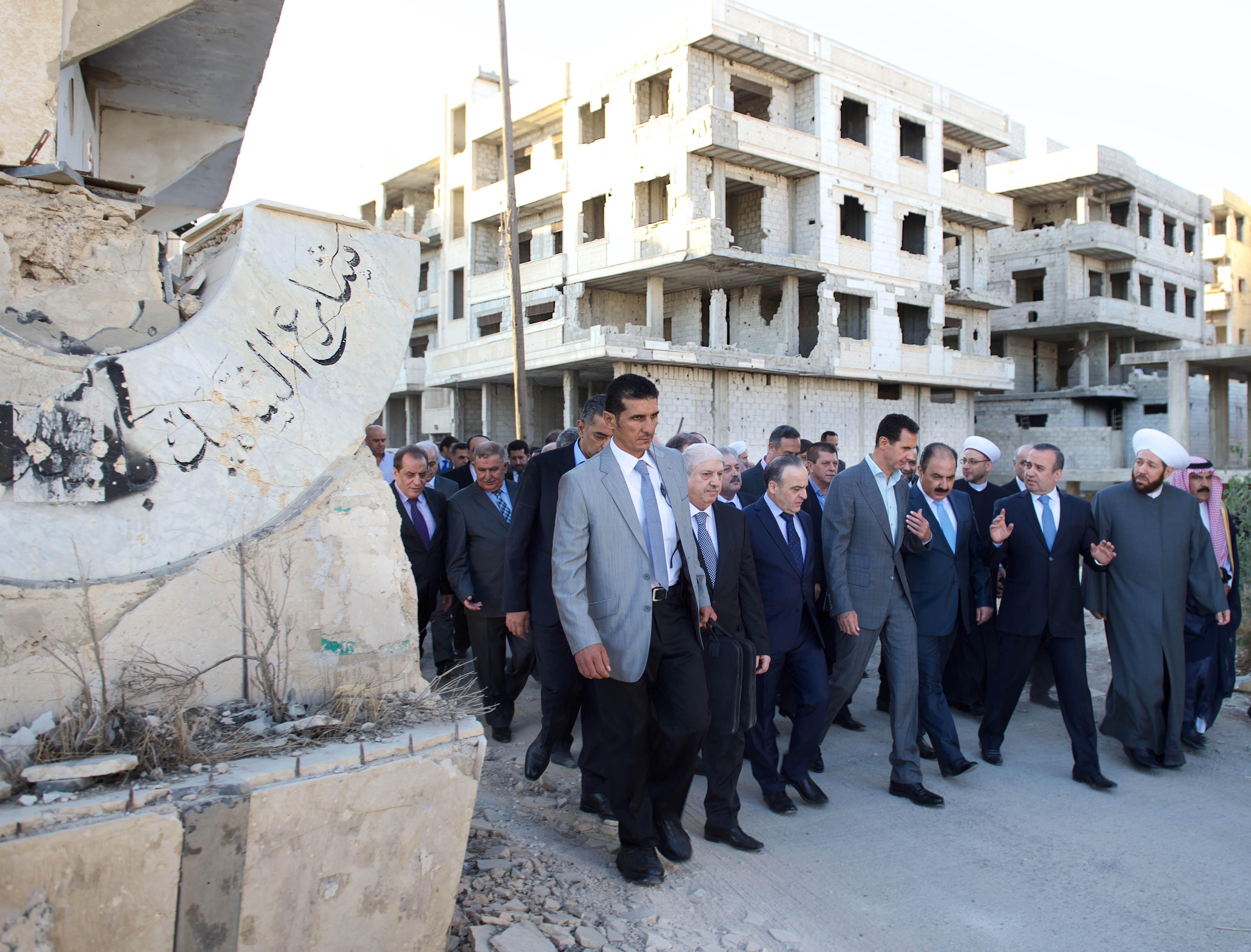
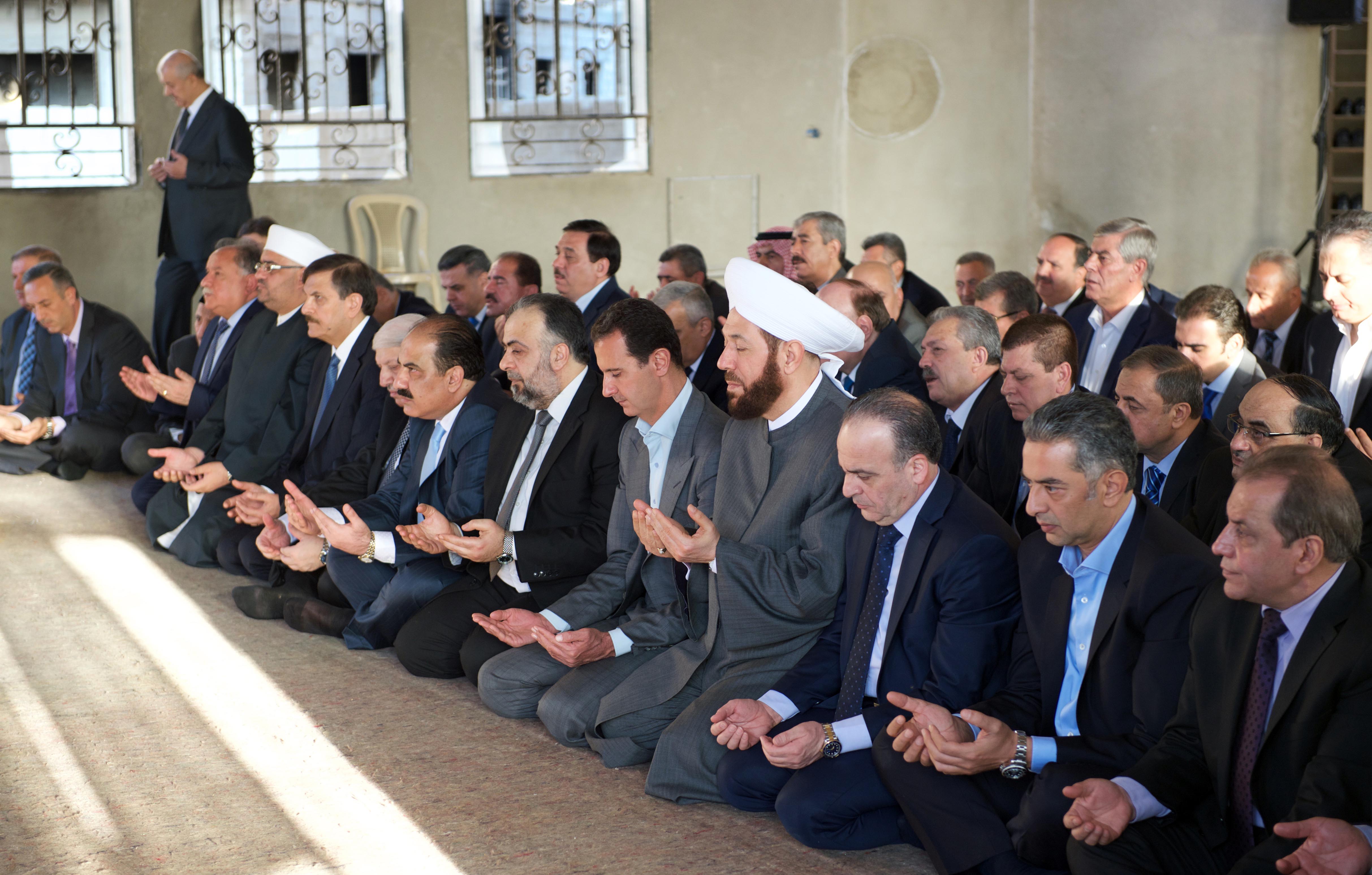
President Bashar al-Assad performed on Monday the prayers of Eid al-Adha (Feast of the Sacrifice) at Saad Ibn Muaz Mosque in Daraya city in Damascus Countryside.
A number of state officials, ministers, MPs and Muslim scholars also observed the prayers, which were led by sheikh Adnan al-Afiouni, Mufti of Damascus and its countryside.
Eid al-Adha festival, which marks the end of the annual Muslim pilgrimage of Hajj to Mecca, commemorates the willingness of Prophet Ibrahim to follow God’s command to sacrifice his son Ismael.
president-al-assad-eid-al-adha-prayers-daraya-5
Sheikh al-Afiouni delivered the Eid sermon, saying Eid al-Adha this year gives the Syrians hope for the end of the crisis in the country thanks to the Syrian Arab Army and the victories it has achieved.
He also referred to the recent reconciliation agreements, where civilians and gunmen have been evacuated from cities in Damascus countryside and Homs, which he said indicates that those who want to go back on the right track always find the doors of the homeland open for them.
Sheikh al-Afiouni saw in President al-Assad’s choosing of Daraya city to perform the Eid prayers an indication of embarking on reconstruction in the terrorism-stricken city after the evacuation of civilians and militants has been completed.
It is also a proof that the Syrian state is honest and sincere in taking care of all parts of the homeland, he said.
“Together with you Mr. President we will rebuild modern Syria and make it more beautiful, powerful and developed than it has been,” added al-Afiouni.
Following the prayers, President al-Assad toured a number of streets in Daraya city and saw the damage inflicted upon the infrastructure, places of worship and public and private properties due to the terrorist attacks.
He listened to reviews by the officials concerned on their recent visits to Daraya city after the evacuation process and was briefed on the plans set up for restoring services to the city so that people can return to their homes as soon as possible.
In statements to the national media, the President said “Visiting Daraya today has plenty of meanings. They may be symbolic, but they are not addressed to the Syrian people as I and the Syrian people… have been in the same situation since the beginning of the crisis.”
He added that the Syrian people have been aware of the reality of the conspiracy and the existence of traitors and agents and the external factor and share the same feelings whenever an area is taken by the terrorists, or liberated by the army or when a reconciliation agreement is achieved.
president-al-assad-eid-al-adha-prayers-daraya-8
The President affirmed that the message of his visit to Daraya is addressed to those who have worked against Syria and bet on its collapse, especially those countries that got directly involved in conspiring against Syria and supporting the terrorists and the Syrian traitors and agents who chose to be part of the foreign plot.
“We as state, by coming to this area, also send a message to those [sides] that the Syrian state is determined to retake every area from the terrorists and restore security and safety,” stressed the President, adding that the state is also resolved to reconstruct all that has been destroyed physically and on the human level.
“We come here today to replace the false freedom they tried to market at the beginning of the crisis, including about Daraya, with the real freedom; the freedom that starts with restoring security and safety, goes through reconstruction and ends with the independent national decision,” said President al-Assad.
He reiterated that the message is addressed especially from Daraya “since there are some who were annoyed that [Daraya] was brought back home and had issued official statements, and they are Western officials.”
He addressed those parties saying “You are sad and extremely distressed, whereas we are happy; firstly because Daraya is back, and secondly because you are sad and distressed,” adding that the when the conspirators reach a point where they are feeling distressed, “it means that things are going in the right direction.”
The President dismissed as “malicious” and “dangerous” the talk about “demographic changes” being attempted by the Syrian state in the areas taken from the terrorists or where reconciliations happen.
He went on saying that this talk targets not only Daraya but Syria as a whole as it aims at creating the impression that the Syrian society is dismembered where social groups are at odds with each other to show that the Syrian cities are divided along sectarian, racial or religious lines.
The President however affirmed that there is no need to worry about this issue as this game has been played so many times, and that it has now become difficult to market such a concept as “demographic change” because the Syrian people have high-level awareness and they have learned a lot throughout the crisis.
As for his message regarding the areas that are still under the gunmen’s control, President al-Assad called on the Syrians to walk towards reconciliation, stressing that experience, especially over the past three years, showed that the Syrian state has kept all its promises and has always been open for reconciliation and for stopping the bloodshed.
The doors of the homeland, he reiterated, will always be open to those who want to get back on the right track at any time and at all levels .
“However, those who are determined and insist on acting as tools in return for a handful of dollars, we simply say to them ‘the armed forces will continue their work unhesitant and undaunted and regardless of any internal or external conditions until restoring security and safety to all areas in Syria,” the President said.